RFID payments offer a flexible way to make payments at events while also helping organizers simplify operations and gain useful insights. Here are seven key benefits of using RFID payments at events:
- RFID payments enable fast transactions and can help reduce queues at food, beverage, and merchandise points.
- Cashless payment systems simplify post-event accounting by allowing purchases made by one person or multiple people from the same company group to be combined on one invoice.
- RFID tags can have different spending settings. You can load a specific amount onto a tag, set a spending limit, or allow purchases without a predefined limit.
- Payment systems also collect data from purchases made using RFID tags, giving event organizers a broader view of event sales and purchasing behavior.
- CoreGo provides RFID payment solutions for events, including setup and on-site support.
- RFID wristbands and smartcards reduce the need to handle cash at event payment points.
- RFID payments can make the attendee experience smoother by allowing payments through a single event-integrated tag.
Why RFID payments can improve events
1. Faster payments can mean shorter queues
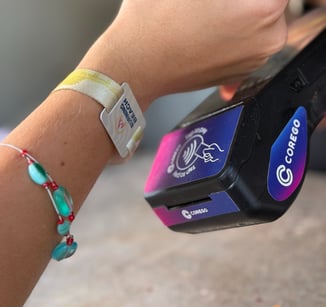
Long queues at food and beverage points can frustrate attendees and affect the overall event experience. RFID technology enables fast transactions. Attendees simply tap their wristband or smartcard on a reader to complete the payment without handling cash.
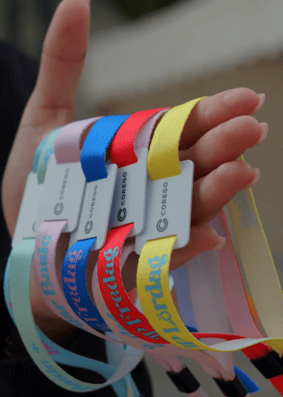
When this is repeated across thousands of attendees, smooth payment processes can make busy payment points easier to manage. Attendees spend less time dealing with payments and more time enjoying the event.
2. Flexible spending settings for RFID tags
RFID tags can be configured with different spending settings depending on the needs of the event and the user. A specific amount can be loaded onto a tag, a spending limit can be set, or purchases can be allowed without a predefined limit.
This makes it possible to create different payment setups for regular attendees, staff, VIP guests, or corporate customers. Payments can be made using an RFID wristband or smartcard, reducing the need to handle cash for every purchase.
3. Data from RFID purchases and event sales
RFID payments provide event organizers with data from purchases made using RFID tags. The payment system collects information about transactions, giving organizers a better overview of event sales and purchasing behavior.
This data can be used during and after the event to support event development. When organizers have information about what attendees are purchasing and how sales are developing, they can make decisions based on available data.
4. Easier post-event accounting
Paying with an RFID wristband or card makes post-event invoicing easier. At corporate events, one person’s purchases can be combined into a single invoice, and purchases from several people within the same company can also be grouped together.
This reduces the need to handle individual receipts and invoices, making post-event financial management easier.
5. Less cash handling
Handling cash at events requires additional work and administration. RFID payments allow attendees to pay without using cash, reducing the amount of cash that needs to be handled at payment points.
RFID tags are also individually identifiable, making them easier to manage within the payment system. If a tag is lost, it can be deactivated and replaced with a new one when needed.
6. A smoother attendee experience
Attendees want to focus on enjoying the event rather than dealing with payment-related practicalities. An RFID wristband or smartcard provides an event-integrated payment method that is easy to carry and use.
Other event functions and benefits can also be connected to the same RFID tag, such as access rights or digital benefits. This allows attendees to use multiple event services with a single tag.
7. Valuable data on purchasing behavior
The data generated through RFID payments goes beyond individual transactions. Event organizers can use the data to better understand what attendees are purchasing and how purchasing behavior develops during the event.
This information can support the planning and development of future events. When organizers have access to data from previous events, they can make more informed decisions about product selections, payment points, and the overall event experience.
How to get the most from RFID payments at your event
Implementing RFID payments does not have to be complicated. The key is choosing a technology partner that understands the specific requirements of events and can support the organizer from planning and setup through to the live event.
CoreGo provides RFID payment solutions for events, along with payment terminals, software, integrations, and on-site support. The solution can be tailored to the needs of each event, whether it is a festival, sporting event, corporate event, or another large-scale public event.
Frequently asked questions about RFID payments at events
What does RFID payment mean?
RFID stands for Radio Frequency Identification. In events, RFID payments typically use a wristband or card containing a chip that communicates wirelessly with a payment terminal. When an attendee taps their wristband or card on the reader, the payment can be completed.
How can RFID payments help reduce queues at events?
RFID payments enable fast transactions without the need to handle cash. When payments are completed quickly, payment points can serve customers efficiently and queues may be reduced.
Can you set a spending limit on an RFID tag?
Yes. RFID tags can be configured with different spending settings depending on the needs of the event. A specific amount can be loaded onto a tag, a spending limit can be set, or purchases can be allowed without a predefined limit.
Can purchases from multiple people be combined on one invoice?
Yes. Purchases can be combined on one person's invoice, or purchases made by multiple people from the same company group can be combined into a single invoice. This can be particularly useful for corporate and VIP events.
What data can be collected from RFID payments?
RFID payments generate data from purchases made using RFID tags. This information can be used to analyze event sales and purchasing behavior and to support the development of future events.
What happens if an RFID wristband is lost?
A lost RFID tag can be deactivated in the system and, if needed, replaced with a new tag. This prevents the lost tag from being used.
How does CoreGo support event organizers with RFID payments?
CoreGo provides RFID payment solutions that can include payment terminals, software, integrations, and on-site support. The CoreGo team supports event organizers with planning, setup, and the live event.